

Small rooms are brutal on bookshelf speakers. One minute you’ve got them crammed on a desk, the next they’re balanced on a random shelf, and everything sounds either boomy or boxed‑in. You don’t really hear the speakers; you hear the furniture. Once you start taking your monitoring seriously—whether it’s mixing, practicing keys, or just listening—it becomes obvious that the “stands” you improvise matter just as much as the boxes you bought.
The good news: you don’t need giant floor towers to fix it. You just need to get those monitors to the right height, angle, and distance from the wall—and in a small room, that’s exactly what well‑chosen stands or wall brackets, are for.
According to the architectural audio guidelines from Audioholics, the most significant risk is boundary reinforcement; placing a speaker directly against a wall typically causes a boost in low-frequency output, which can result in “boomy” or muddy bass if not accounted for via the speaker’s “boundary” or “half-space” EQ settings
Why Height and Position Matter More Than Brand
Most nearfield speakers are designed to work with the tweeter around ear height and the cabinets forming a loose triangle with your head. Drop them six inches too low and the top end dulls out; park them in the corners and the bass turns to mush. Proper stands or mounts let you set that height once and then nudge speakers forward or back from the wall until the low end tightens up instead of booming in your lap.
In tight rooms, isolation is the other half of the equation. When monitors sit directly on a desk or bookshelf, the surface starts vibrating along with them, smearing the stereo image and exaggerating certain frequencies. Stands with rubber tops or separate isolation pads break that connection so you hear more of the speaker and less of the furniture ringing along for the ride.
Floor Stands in Small Rooms: When They Still Make Sense
Floor stands are the traditional answer and they’re still hard to beat if you can spare a bit of footprint. A decent pair gives you adjustable height, a stable base, and enough mass that you can move speakers in small increments until vocals snap into the center and kick drums stop sounding like they’re stuck in a box. Filled or heavy bases also mean you can bump the desk or walk around without your monitors wobbling on every step.
The trade‑off is space and safety. Two stands plus cables in a tiny bedroom or project studio turn into obstacles fast—especially if you share the room with kids, pets, or a rolling chair. In those cases, you’re often better off getting the speakers off the floor entirely instead of trying to dance between three tripods every time you sit down.
Wall Mounts: The Small‑Room Cheat Code
Wall mounts are the opposite approach: fix the speakers to the wall and give the floor back to the rest of your life. For small rooms where the listening position doesn’t move much, that’s a huge win. You can place the brackets just wide enough for a good stereo spread, get the tweeters roughly at ear height, then run cables straight down the wall or inside trunking so everything looks intentional instead of patched together.

The catch is flexibility. Once you drill, you’re committed. If you later move the desk or change the listening distance, you either live with a less‑than‑ideal angle or patch holes and start again. That’s where adjustable brackets start to earn their keep: the more you can swivel and tilt the platform, the more wiggle room you have before you ever touch a drill again.
Why Adjustable Wall Brackets Are Ideal for Bookshelf Monitors
Bookshelf monitors rarely land at perfect ear height on the first try, especially when wall studs dictate where hardware can go. Brackets that offer real adjustment—swivel left/right plus a bit of tilt—let you mount slightly higher or wider than ideal, then “aim” the speakers so they still lock onto your listening spot. That’s a lifesaver when your only practical mounting points are above the desk line or closer to a corner.
Weight capacity and build matter here more than looks. Good brackets for bookshelf speakers are all metal, use proper welds, and are rated comfortably above your speaker’s actual weight so they don’t sag over time. A strip of rubber or small isolation pad between speaker and shelf finishes the job by cutting down the amount of vibration that makes it into the wall itself.
Product Deep Dive
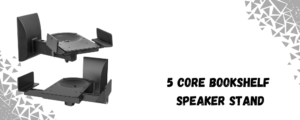
5 Core Adjustable Speaker Wall Mounts – 11″ Bookshelf Brackets (Pair)
These 5 Core wall mounts are built exactly for the “no floor space, real speakers” scenario. Each bracket uses a steel frame with an 11‑inch‑deep platform and side lips to keep typical bookshelf cabinets safely in place, even if the wall isn’t perfectly level. The mounting plate offers multiple bolt holes so you can hit studs or solid masonry, and the pair is rated for substantial loads—more than enough for the kind of compact monitors that live in small studios and living rooms.
Key Features
- Adjustable swivel platform so you can toe speakers toward your listening spot without moving the bracket itself.
- Tilt capability that lets you angle monitors down slightly when they’re mounted above ear height.
- Welded steel construction with corrosion‑resistant coating for long‑term use on brick, concrete, or stud walls.
- 11‑inch‑deep shelves sized to handle most bookshelf and small studio monitors without hanging off the edge.
- Cable‑friendly layout that leaves room to route wires behind or alongside the bracket for a clean install.
The Takeaway
In a small room, the “best” stands are the ones that solve two real problems at once: getting your speakers to the right height and angle, and getting them out of your way. Traditional floor stands still make sense when you have a bit of space and want maximum flexibility; adjustable wall brackets shine when every square foot counts and you want a setup that looks finished instead of improvised.
Either way, once the monitors are properly supported and isolated, the speakers you already own will usually sound better than they ever did balanced on a desk or jammed into a bookshelf.
Here you can also find amazing drum thrones; alternatively, browse our product page to find the best keyboard bench, audio mixers, drum mics, piano bench, keyboard stand, speakers, party speakers, and more.