

Speaker stands only do one real job: put the drivers where your ears expect them to be. Most home and studio speakers are voiced assuming the tweeter is close to ear level at the main listening spot; move that point too high or low and the top end, imaging, and sense of “center” all shift. A bit of measuring before you buy or set height saves a lot of aimless tweaking later.
According to the setup guides at Sound on Sound, high-frequency sounds are very directional; if your stands are too short or too tall, you will lose the “sparkle” and detail in the music, and the stereo image will feel blurry. If you can’t find the perfect height, it is better to go slightly shorter and use isolation wedges to angle the speakers upward toward your face, ensuring the sound hits your ears directly rather than bouncing off your desk or floor
Measure Your Ear Height and Tweeter Offset
Start with the listening position, not the catalog.
- Sit in your normal chair and measure from the floor to the center of your ear; that number—often around 34–40 inches for seated adults—is your target tweeter height.
- On the speaker, measure from the bottom of the cabinet to the center of the tweeter. Subtract that from your ear height:
- Stand height ≈ Ear height – Tweeter‑from‑base height.
If the result falls between two notches or ranges, most placement guides suggest going slightly above rather than well below ear height, as being a touch off‑axis from above is usually less damaging than having the tweeter fire at your chest.
Adjust for Room and Use Case
Once you have a baseline, you can bend it a little for context.
- In a stereo or mix position, keep left and right tweeters at the same height and angle them so the front baffle “looks” at your head, forming a rough equilateral triangle between both speakers and your seat.
- In casual living‑room setups with multiple seats, align to the main seat and accept that others will sit slightly off; big differences in height between stands do more harm than a small compromise at secondary spots.
- For small PA or rehearsal use where listeners stand, treat typical standing ear height—about 60–65 inches—as your reference instead, and run the horns just above that so sound clears the front row.
How the 5 Core and Gator Stands Help You Hit the Number
Both stands you listed sit in the “short to mid” range that works well once you have done the math.
5 Core PA/DJ Tripod Stands (2pc)
The 5Core stands are a matched pair of steel tripod speaker stands with 35 mm pole inserts, adjustable from 31″ to 54″ height, supporting up to 132 lb per stand for full-size PA cabinets, DJ tops or powered monitors in live sound, events or rehearsal spaces. Featuring locking pins, tension knobs, anti-slip rubber feet and a wide tripod footprint, they fold compactly with an included carry bag, making them ideal for mobile DJs, bands, or installers needing robust, matched-height support without premium pricing.
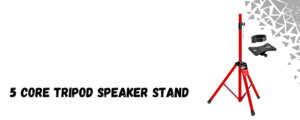
- Pair of heavy-duty tripods: 31″–54″ height, 132 lb capacity each, 35 mm pole, folding design with carry bag.
- Steel construction, safety pin/knob locks, rubber feet for stability on varied surfaces.
- Best for: full PA/DJ rigs, events and mobile setups requiring maximum load and matched pairs.
Gator Frameworks GFWSPK0250 Mini Stand
Gator Frameworks GFWSPK0250 is a single low-profile tripod speaker stand designed for compact PA speakers, column arrays or monitors, with height adjustment from 28.25″ to 46″ and 60 lb capacity to maintain sightlines and minimize trip hazards in tight venues. Its smaller footprint and soft-touch height knob prioritize discreet placement over heavy loads, suiting conference rooms, small stages or desktop monitors where full-height elevation isn’t needed.
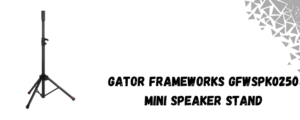
- Single mini tripod: 28.25″–46″ height, 60 lb capacity, low-profile base.
- Soft-touch adjustment, standard mounting tube for small/medium tops.
- Best for: short-throw PA, installs, and spaces prioritizing clearance over heavy-duty support.
Conclusion
Choosing the right stand height is a straightforward measurement problem: know your ear height, know the tweeter offset, and pick a stand that can bridge the difference with a little adjustment range. Adjustable, short‑throw tripods like the 5 Core 31–36″ pair and Gator’s GFWSPK0250 make it easy to hit that alignment in real rooms, so the speakers you already own can image properly instead of firing over or under the listening position.
Here you can also find amazing drum thrones; alternatively, browse our page to find the best keyboard bench, audio mixers, drum mics, piano bench, keyboard stand, speakers, party speakers, and more.